You have 0 items in your cart


A low air loss mattress system is a powered mattress for a person confined to bed for long stretches. It replaces or lies over a standard mattress and connects to a pump that runs continuously. This system combines two therapies in one surface — low air loss and alternating pressure — for patients at risk of pressure injuries from extended bed rest. It fits a standard hospital bed frame.

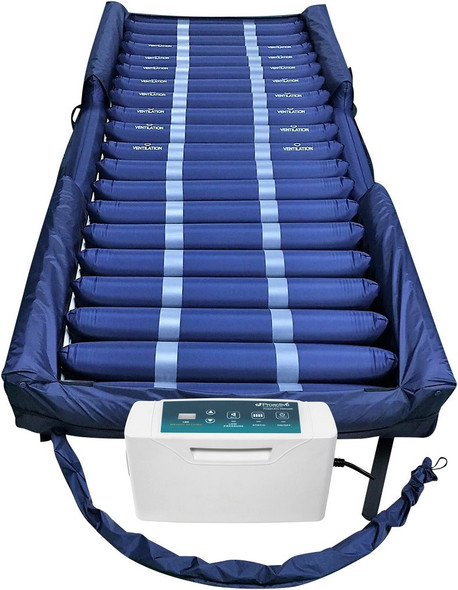
The mattress surface has thousands of tiny laser-drilled holes that push a steady stream of air up against the skin. The airflow carries away heat and moisture, keeping the skin cool and dry. Damp, warm skin breaks down faster under pressure, so moisture control is central to what this surface does.
Low air loss and alternating pressure are different, and this system does both. Alternating pressure works by movement: the air cells inflate and deflate on a timed cycle, so the points of the body bearing weight shift every few minutes instead of resting in one place. The pump cycle time is adjustable. Where low air loss manages the skin surface, alternating pressure keeps any single area from bearing weight continuously.
The air cells are built in two layers. The top layer alternates for therapy; the bottom layer stays inflated to hold the patient up. If power is lost or the patient needs to be moved, the bottom layer keeps the mattress from collapsing. A quick-connector cap holds the air in during transport.
The digital pump auto-senses and adjusts air pressure to the patient’s weight. It runs several modes: alternating for therapy, static for a still surface, max-firm for transfers and repositioning, and seat-inflate to firm the seat area. A low-pressure alarm signals a leak or a loose connection.
The top cover is a two-way stretch fabric that is low-shear, water-resistant, vapor-permeable, and anti-microbial. A CPR quick-release strap at the head deflates the mattress in seconds if chest compressions are needed.
This system is for patients on extended bed rest with limited mobility who are at risk of pressure injuries — in home care, hospice, or recovery. The manufacturer states the system is intended to reduce the incidence of pressure ulcers while optimizing patient comfort. Whether it is appropriate, and at what pressure settings, is a decision for the patient’s doctor or wound care nurse.
| Therapy | Low air loss + alternating pressure |
| Air cells | 20, TPU, cell-on-cell (two-layer) |
| Mattress height | 8″ |
| Weight capacity | Up to 400 lbs (bariatric version to 660) |
| Pump | Digital, auto-sensing, 8 lpm |
| Modes | Alternating, static, max-firm, seat-inflate |
| Cover | 2-way stretch, low-shear, water-resistant, vapor-permeable, anti-microbial |
| Safety | CPR quick-release, power-outage protection, low-pressure alarm |