You have 0 items in your cart

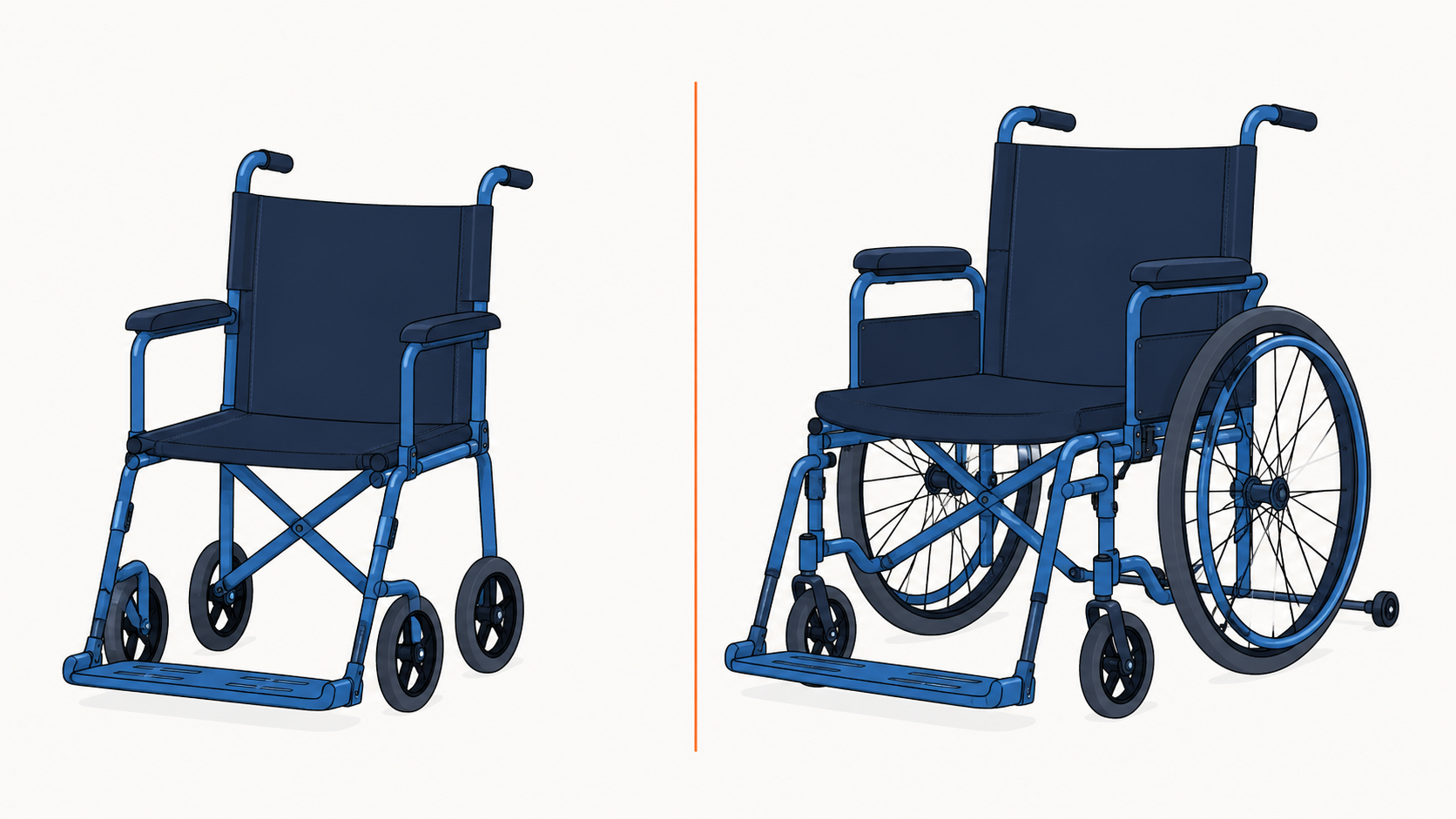
The wheelchair vs transport chair question comes down to one thing: who is going to push it?
A transport chair has four caster wheels and no hand rims, so someone else does the pushing. A standard wheelchair has large main wheels with hand rims, so the wheelchair user can move independently. Every other difference between the two mobility devices — weight, narrower frame, folded size, price, comfort over long distances — follows from that single design choice.
The two look extremely similar sitting side by side in a showroom, which is exactly why people buy the wrong one. This page walks through the key differences so you don’t.
A transport chair is a lightweight mobility device intended to be pushed by a caregiver rather than propelled by the person seated in it. It has four small wheels, no hand rims, and typically weighs between 15 and 25 pounds. The compact frame folds flat for a vehicle trunk or a hall closet.
Removing the large rear wheels is what makes the chair light. A transport chair commonly weighs 40 to 50 percent less than a comparable standard manual wheelchair, which is the entire reason the category exists — one person can lift it into a car without assistance.
Rear wheel sizes vary more than people expect. Most transport chairs run 8-inch rear wheels, which turn tight in hallways, elevators, and exam rooms. Some models use 12-inch padded rear wheels instead. The larger wheel rolls noticeably better over sidewalk cracks, thresholds, and gravel, at the cost of a slightly wider folded profile. If most of the pushing happens outdoors, the 12-inch is worth asking about.
Armrests are usually fixed rather than removable, and many models feature desk-length or restaurant-style arms that roll under a table. Leg rests either swing away or are fixed in place, depending on the model. Frames are most often aluminum, with steel used on heavier-duty and lower-cost models.
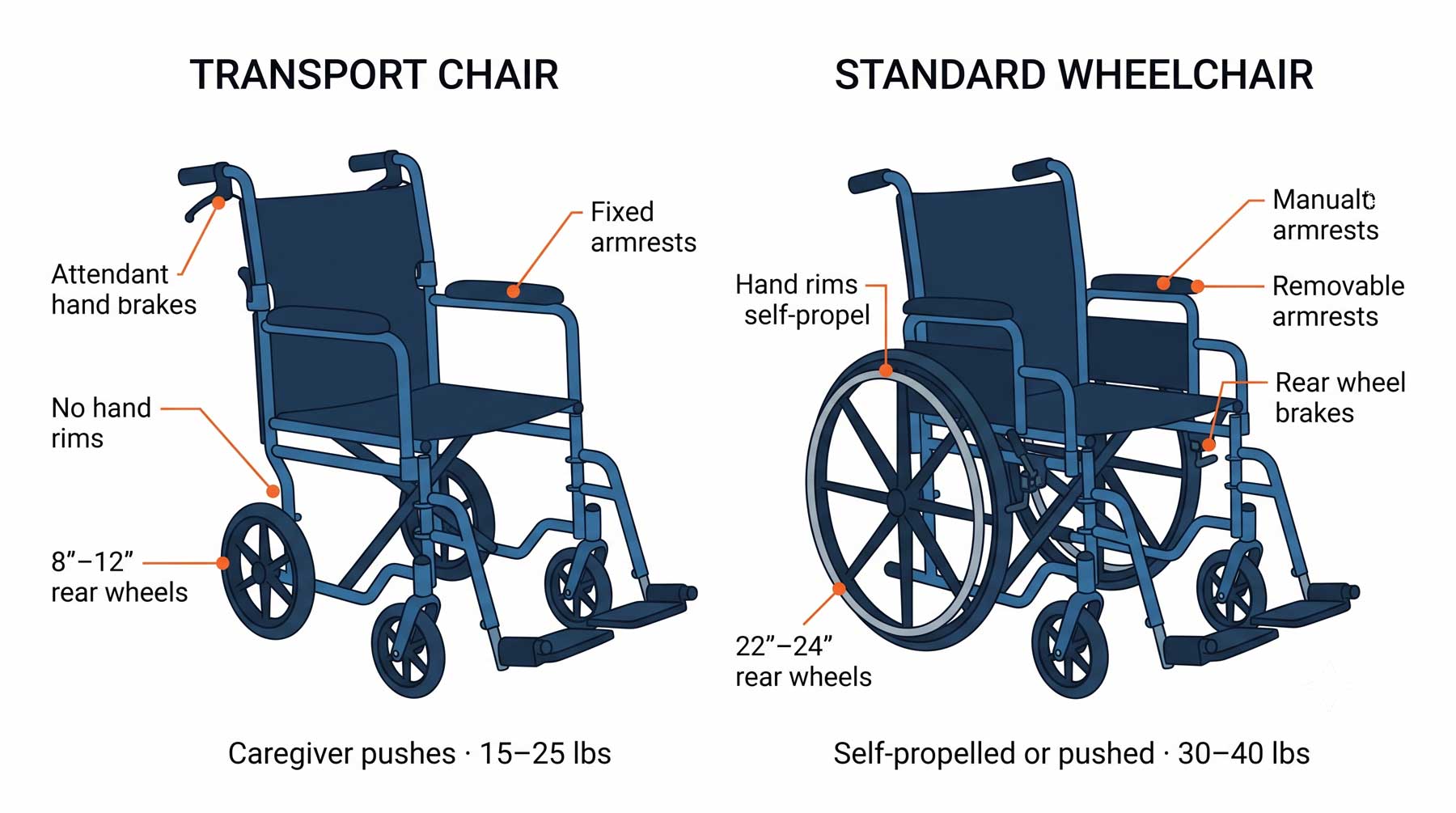
A standard wheelchair has large rear wheels — typically 22 to 24 inches — fitted with hand rims that allow self propulsion. Smaller caster wheels at the front handle steering. A caregiver can still push it from behind when needed, so a standard manual wheelchair does both jobs rather than one.
The tradeoff is weight and bulk. A standard folding wheelchair generally runs 30 to 40 pounds, and the large main wheels make it harder to lift and store. Some models use quick-release axles so the wheels come off for transport, which helps considerably.
Standard wheelchairs also carry additional features a transport chair usually doesn’t: anti-tippers at the rear for stability, and removable or swing-back armrests that make side transfers noticeably easier. They are built for daily living rather than occasional outings, and the frame and upholstery are specified accordingly.
Who moves the chair. A transport chair is pushed by a caregiver. A standard wheelchair supports self-propulsion by the user or pushing by an attendant.
Rear wheels. Transport chairs use 8-inch to 12-inch rear wheels. Standard wheelchairs use 22-inch to 24-inch main wheels.
Hand rims. Transport chairs have none. Standard wheelchairs have hand rims on both rear wheels.
Typical weight. Transport chairs weigh 15 to 25 pounds. Standard manual wheelchairs weigh 30 to 40 pounds.
Frame width. Transport chairs have a narrower frame overall, which clears tight doorways more easily.
Armrests. Transport chair armrests are usually fixed. Standard wheelchair armrests are often removable or swing-back.
Brakes. Transport chairs use attendant-operated hand brakes on the push handles, sometimes with wheel locks. Standard wheelchairs use rear-wheel brakes that the user can reach and set from the seat.
Anti-tippers. Transport chairs usually do not include them. Standard wheelchairs typically do.
Folded size. A transport chair folds compact and fits most car trunks. A standard wheelchair is bulkier, though the main wheels may detach.
Intended use. Transport chairs are suitable for short journeys and temporary use. Standard wheelchairs suit long term daily mobility.
The brake difference matters more than most buyers realize, and it follows directly from who is doing the pushing.
On a standard wheelchair, the rear-wheel brakes are within reach of the seated user, who can lock the chair before standing or transferring. On a transport chair, the brakes are usually squeeze levers on the push handles, operated by the caregiver. Some transport chairs add rear wheel locks, but primary braking is an attendant function. If the person using the chair will ever be left alone in it, that distinction is a safety consideration, not a convenience one.
Wheel size governs how each device behaves in indoor and outdoor use. Small caster wheels pivot beautifully on smooth floors and pull the chair through tight turns with almost no effort. Outdoors, those same wheels drop into pavement seams and stall on thresholds, and the caregiver absorbs the difference. Large main wheels roll over obstacles rather than catch on them, which is why a self-propelling wheelchair user can navigate sidewalks and curb cuts that would stop a transport chair.
Transport chairs feature minimal padding, because they are built for short durations. The seat and back are usually a single layer of nylon over a folding frame — perfectly comfortable for a two-hour appointment, noticeably less so by hour six.
Standard wheelchairs accommodate a far wider variety of custom cushions and ergonomic adjustments. Gel, foam, and air-cell cushions all fit standard seat dimensions. Backrest height, seat depth, footrest length, and armrest position are commonly adjustable, and customizable options include specialized cushions for pressure relief on chairs used for many hours a day.
That gap is why transport chairs are not suitable for long-term daily use. For someone with limited mobility who spends most of the day seated, a chair without cushion support or postural adjustment creates real problems. For someone recovering from surgery who needs a chair twice a week for six weeks, none of that applies, and the lighter chair is the better answer.
Choose a transport chair if someone will always be available to push. It is a great option for medical appointments, airport travel, family outings, and temporary recovery after surgery or injury. It also fits the person who can walk but tires quickly and needs the chair only for long distances. And it is the practical answer when the chair has to live in a sedan trunk and get lifted in and out by one person several times a week — the convenience of a compact frame is not a small factor in daily life.
Choose a standard wheelchair if the person using it wants or needs to move without waiting for assistance. That independence matters more than most families anticipate before they need it. Being able to cross a room or reach a counter on your own terms is central to daily living, and self-propulsion is the only means of doing so. A standard wheelchair is also the better choice for long-term use, for anyone spending hours in the chair, and for situations where transfers happen often enough that removable armrests earn their keep.
When the answer is both: plenty of households end up with a standard wheelchair for home mobility and a transport chair for outings. If the budget only supports one, a standard wheelchair is preferable, since it can always be pushed.
The right choice depends on individual needs, the frequency of use, and the environment the chair will actually live in. Nobody can answer it from a spec sheet alone.
Three mistakes keep coming up at our counter.
Buying a transport chair for someone who still wants independence. This is the most common one, and it is usually well-intentioned — the family picks the chair that is easiest to carry. Then the person sitting in it discovers they can’t move an inch without asking. If independence is on the table at all, ask the person using the chair before you decide.
Underestimating how caster wheels behave outdoors. Eight-inch wheels are excellent indoors and unpleasant on a cracked Los Angeles sidewalk. They catch on thresholds, drop into pavement seams, and demand real effort from whoever is pushing. If your route includes uneven ground, look at 12-inch rear wheels or a standard wheelchair.
Guessing at seat width. Seat width is measured hip to hip while seated, not by clothing size and not by eye. Too narrow is uncomfortable and unsafe. Too wide costs efficient self-propulsion and makes doorways tighter. This takes about two minutes to get right in person.
Portability is where transport chairs earn their reputation. A folded transport chair fits behind the driver’s seat of most sedans, stands upright in a closet, and can be carried up a short flight of steps by one person. Aluminum frames keep the weight down; steel frames cost less and weigh more.
A standard wheelchair asks more of you. Folded, it still occupies most of a trunk, and the main wheels are the reason. Quick-release axles solve much of the problem — pull both wheels and the remaining frame stores in roughly the same footprint as a transport chair — but it becomes a two-step process every time the chair goes in or out of the vehicle.
For families whose routine involves loading the chair several times a week, that difference compounds fast. For families whose chair mostly stays in the house, it hardly matters. Which of those describes your situation is usually the deciding factor between the two.
Renting makes sense when the need has an end date. Post-surgical recovery, a visiting relative, a single trip, six weeks in a cast — in those cases a rental costs a fraction of a purchase and you hand the equipment back when you’re done. Wishing Well Medical rents transport wheelchairs and standard wheelchairs by the week and by the month.
Buying makes sense when the need is ongoing or indefinite. Purchase prices on both chair types are generally recovered within a few months of equivalent rental, so if the horizon runs past a couple of months, buying is usually the better math.
The showroom is the part you can’t get online. Sitting in both chairs, folding both chairs, and lifting both chairs into your own trunk answers the question faster than any comparison chart. Wishing Well Medical has kept wheelchairs and other home mobility equipment on the floor in West Los Angeles since 1976, and our staff fits people to chairs every day.
We deliver throughout Los Angeles County for a distance-based fee, and our on-site technicians service what we sell. Payment is by cash or card. We do not bill insurance.
Call (310) 829-1777 or visit us at 12420 Santa Monica Blvd. in West Los Angeles.
A transport chair is pushed by a caregiver, while a standard wheelchair has large rear wheels with hand rims that allow the user to self-propel. Transport chairs weigh 15 to 25 pounds and fold compactly. Standard manual wheelchairs weigh 30 to 40 pounds and can be either self-propelled or pushed.
A transport chair cannot be self-propelled, because its rear wheels are small and have no hand rims. Someone else pushes the chair from behind. Choose a standard wheelchair with 22-inch or 24-inch rear wheels if the person using it needs to move independently.
Most transport chairs weigh between 15 and 25 pounds, and the lightest aluminum models come in under 15 pounds. That is commonly 40 to 50 percent less than a comparable standard manual wheelchair. The lighter frame is what makes a transport chair practical for one person to load into a vehicle.
Transport wheelchairs push easily on smooth indoor floors but require more effort outdoors, because small caster wheels catch on cracks and thresholds. Models with 12-inch rear wheels roll more smoothly over uneven ground. Call us at (310) 829-1777 if most of your pushing will happen outside.
Transport chairs are not suitable for long term daily use, because they offer minimal padding and few postural adjustments. They are intended for short journeys and temporary use such as appointments and travel. A standard wheelchair with proper cushions is the better choice for someone seated most of the day.
Most transport chairs measure 22 to 25 inches in overall width, with seat widths commonly running 17 to 19 inches. The narrower frame clears tight doorways more easily than a standard wheelchair. Measure the narrowest doorway at home before you buy, and measure seat width hip to hip while seated.
A transport chair is a type of wheelchair, specifically an attendant-propelled manual wheelchair. Most airlines, venues, and accessible facilities treat transport chairs and wheelchairs the same way for access purposes. The functional difference is that a transport chair does not support self propulsion.
Wishing Well Medical does not bill insurance or Medicare for transport chairs or any other mobility equipment. Coverage rules vary by plan, and any reimbursement question is between you and your insurer. We accept cash and card, and we are happy to provide a receipt for your own submission.
Wishing Well Medical keeps transport chairs and standard wheelchairs on the showroom floor at 12420 Santa Monica Blvd. in West Los Angeles. You can sit in both, fold both, and lift both before deciding. Call us at (310) 829-1777 to confirm what is currently in stock.