You have 0 items in your cart


A rollator is a four-wheeled walker with handlebars, hand brakes, and a built-in seat. Rollators give mobility support to people who need help with balance while walking but don’t need to lean heavily on the device to bear weight. A rollator rolls smoothly without lifting and offers a place to rest, making it ideal for both indoor use and outdoor use.
If you or a loved one needs help getting around safely, a rollator is one of the most popular pieces of mobility equipment available. But rollators are often mistaken for standard walkers, and choosing the wrong one can compromise safety, comfort, and independence. This guide explains what a rollator is, how it differs from a walker, the types available, and how to choose the right one for your situation.
A rollator is a wheeled walking aid designed to provide stability and mobility support for people who can walk on their own but need help with balance or endurance. Unlike a standard walker, a rollator has three or four wheels, hand-operated brakes, ergonomic handlebars, and — on most rollators with four wheels — a padded seat and storage basket.
The key advantage of a rollator is that you never have to lift it. You simply push it as you walk, and the wheels roll smoothly over floors, carpet, sidewalks, and rough or uneven terrain. When you need to rest, you engage the brakes and sit down on the built-in seat. This makes a rollator especially useful for anyone who wants to walk longer distances rather than just short distances around the home.
Rollators are sometimes called “rollator walkers,” “rolling walkers,” or “four wheeled walkers,” and they come in a range of sizes, weight capacities, and configurations to fit different needs and lifestyles.
The main difference between a rollator and a walker is how they support the user. A standard walker is a frame you lift or push for weight-bearing support and maximum stability. A rollator rolls on wheels and supports balance rather than full body weight.
A standard walker typically has no wheels or two front wheels, with rubber tips on the rear legs that grip the floor when you press down. This design gives as much stability as possible but requires you to lift or push the walker with each step. A two wheel walker adds wheels to the front legs only, making walking a little smoother while the rear legs still provide grip.
| Feature | Walker | Rollator |
|---|---|---|
| Wheels | 0 to 2 (front legs only) | 3 to 4 |
| Weight support | Supports full body weight | Supports balance, not full weight |
| Movement | Lifted or pushed with each step | Rolls continuously, no lifting |
| Seat included | No | Yes (on most 4-wheel models) |
| Brakes | No | Yes, hand-operated |
| Best for | Recovery, weight-bearing needs | Balance, endurance, active users |
| Indoor/outdoor use | Best indoors, tight spaces | Both, especially outdoors |
A walker is the safer choice for someone who needs to lean heavily on the device to bear weight — for example, after a hip replacement or knee surgery. A rollator is the better choice for someone who can support their own weight but needs more support with steadiness, stamina, or the reassurance of a seat to rest on.
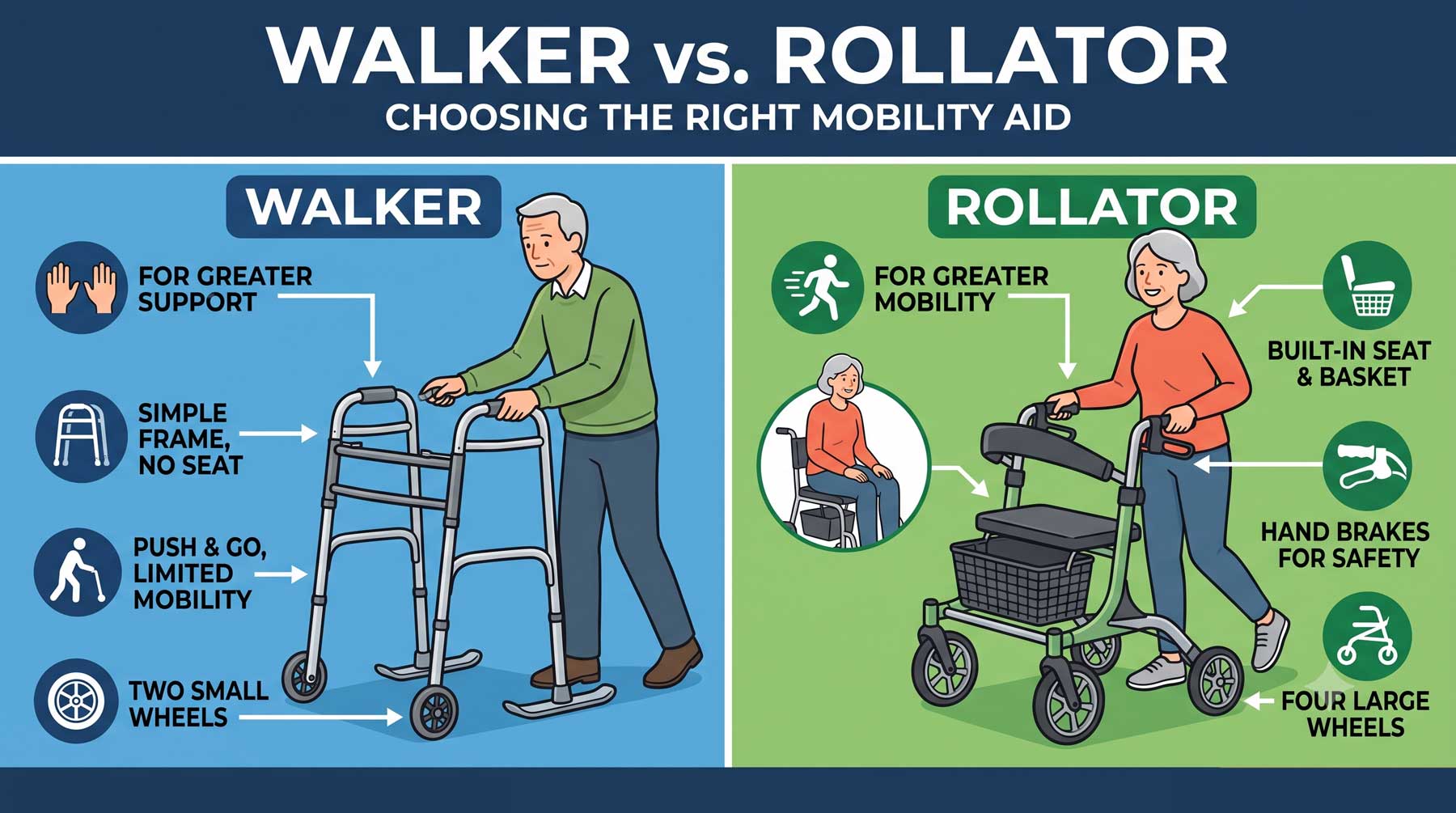
Choose a walker if you need to bear weight on the device while walking, have significant balance or strength limitations, or are recovering from surgery or injury. Standard walkers offer the most stability because all four legs, with their rubber tips, stay in contact with the ground.
Choose a rollator if you can walk on your own but tire easily or need help staying steady, want a seat to rest during longer outings, or need mobility equipment that maneuvers easily both indoors and outdoors. Rollators require more control than walkers because they roll freely, so a certain level of balance and hand strength is important.
Rollators come in several styles, each suited to different needs and environments.
Four-wheel rollators are the most common and versatile type. They include a seat, hand brakes, storage, and stable wheels for everyday use indoors and outdoors. Larger wheels handle rough or uneven terrain and sidewalks with ease, while smaller wheels are better for tight indoor spaces. Most rollators with four wheels fold flat with a simple folding mechanism for easy storage and transport.
Three-wheel rollators have one wheel in front and two in back, giving them a slim, maneuverable profile. They steer easily through narrow spaces like hallways and store aisles and fold compactly for easy storage. Most do not include a seat, which keeps them lightweight and easy to lift into a car.
Upright rollators feature height-adjustable forearm supports instead of low handlebars, encouraging a taller, more natural posture. This design reduces strain on the back, neck, shoulders, and arms and benefits users who experience pain from leaning over a standard rollator.
Bariatric rollators are built with reinforced frames and wider seats to support higher weight capacities. Many heavy-duty rollators support between 400 and 500 pounds, providing the same stability and comfort as standard rollators for larger users.
A rollator is a good fit for people who can walk independently but need more support for balance, endurance, or confidence. Common situations include mild to moderate balance problems, reduced stamina, arthritis, chronic conditions that cause fatigue, or general age-related decline in steadiness.
Rollators are especially helpful for active individuals who want to stay mobile and independent — running errands, carrying items, walking outdoors, or moving around the home — with the security of a stable device and a seat to rest on when needed.
A rollator is not the right choice for everyone. People who need to lean heavily on their mobility device to bear weight should use a standard walker instead, because a rollator’s wheels can roll away if leaned on too hard. Rollators require enough balance, coordination, and hand strength to maneuver the wheels and operate the brakes safely.
People with significant cognitive impairment, severe balance disorders, or very limited upper-body strength may be safer with a walker or another mobility solution. If someone needs as much stability as possible and cannot control a rolling device, a walker is the better option. A doctor or physical therapist can help determine whether a rollator is appropriate for a specific condition.
Modern rollators offer a range of features and add-ons that improve safety and convenience:
Wishing Well Medical carries a full selection of rollators and walkers at our West Los Angeles showroom, where you can try different models before you buy or rent. Our staff can help you compare options and find the right fit for your mobility needs.
We also offer walker and rollator rentals for short-term or recovery needs. Call (310) 829-1777 or visit our showroom to explore your options.